On this page
- The Scams You Will Actually See
- 1. The Fake Payment Screenshot
- 2. The Overpayment Refund Trick
- 3. The Free Sample Request
- 4. The Off-Platform Move
- 5. Gift Card Payments
- 6. Identity Fishing
- 7. Fake Agents, Studios, and Contracts
- 8. Phishing Sites That Copy Real Marketplaces
- 9. Chargebacks After Delivery
- Red Flags You Can Spot in Two Messages
- How to Protect Yourself
- Our Pick for Buyer Volume: FeetFinder
- When a Deal Feels Off
- Frequently Asked Questions
- What is the most common feet pic scam?
- Can someone scam you with a payment screenshot?
- Why do buyers ask to move to Telegram or Snapchat?
- What is the overpayment scam?
- Do buyers ever ask for free samples before paying?
- Are gift cards a safe way to accept payment for feet pics?
- How do I know if a buyer is real?
- What should I do if I already sent content and got scammed?
- Is selling on a platform actually safer than selling directly?
Most feet pic scams come down to a handful of repeat patterns: fake payment screenshots, overpayment refund tricks, free sample requests, pressure to move off platform, gift card payments, identity fishing, fake recruiters, and chargebacks after delivery. You can catch nearly every one of them in the first two messages, because scammers reveal themselves through what they ask you to do, not how their profile looks.
This guide walks through each scam, the exact red flags behind it, and the habits that keep your money and your photos safe.
The Scams You Will Actually See
1. The Fake Payment Screenshot
A buyer sends a screenshot showing they paid, then pushes you to deliver immediately. The payment never arrives, or it shows up from a stolen account and gets reversed weeks later.
The tell is simple. A real payment appears in your own account, on your own device. A screenshot lives on their side, where anyone can edit numbers in a few taps. Until the money is sitting in your balance, nothing has been paid.
2. The Overpayment Refund Trick
Here a buyer "accidentally" sends more than the agreed price, sometimes a large multiple of it. They ask you to refund the difference through another app. You send the refund, then the original payment bounces or gets reversed, and the platform takes the full amount back out of your account.
The loss is real money either way: you paid back cash you never actually received.
3. The Free Sample Request
A buyer asks for one free photo to "prove you are real" before paying. Then another. Then a small custom request, still unpaid, because they are "about to pay."
Sellers who report being scammed overwhelmingly point to this pattern as the entry point. A buyer who respects the work pays first. A buyer who opens with free requests is shopping for free content, and no photo you send will ever be enough to get payment started.
4. The Off-Platform Move
The conversation starts normally, then the buyer suggests moving to Telegram, Snapchat, WhatsApp, or a plain DM "because it is easier." Off a platform with checkout records, you lose every protection at once: no order history, no dispute process, no buyer verification, and no support team when things go wrong.
Direct deals on Discord and Reddit end in chargebacks so often that experienced sellers treat off-platform payment as an automatic decline. Scammers know this, which is exactly why they push for it.
5. Gift Card Payments
A buyer offers Amazon, Apple, Google Play, or Steam gift cards instead of money. The worse version asks you to buy a gift card and hand over the card number and PIN "to verify yourself."
FTC guidance treats requests to buy gift cards and share the codes as a common scam pattern. Gift cards are nearly impossible to trace or reverse, and a code, once shared, is gone.
6. Identity Fishing
The buyer asks for your real name, address, phone number, or social media profiles "to send payment" or "verify you are serious." What they are actually collecting is material for identity theft, harassment, or later blackmail.
A legitimate buyer needs exactly one thing from you: the content you agreed to sell, delivered through the channel you agreed to use. Payment goes through a platform or payment method that does not require your home address.
7. Fake Agents, Studios, and Contracts
In 2026 a growing share of scammers wear a costume: they pose as agents, recruiters, or studios that want to "sign" you. The offer comes with an exclusivity contract, a rights grab, or a request for upfront fees, training kits, or portfolio reviews you must pay for.
Real agencies do not cold-message new sellers with contracts that demand exclusivity before a single sale. And a genuine opportunity never begins with you paying someone.
8. Phishing Sites That Copy Real Marketplaces
A buyer sends a link to what looks like FeetFinder or another known platform and asks you to create an account there. The site is a clone. Everything you type, including your login and payment details, goes straight to the scammer.
Type platform addresses yourself or use your own bookmarks. Never reach a marketplace through a link that arrived in a DM.
9. Chargebacks After Delivery
The buyer pays properly, you deliver, and days later they file a dispute claiming the charge was unauthorized. Payment processors side with buyers far more often than sellers in these cases, and digital goods are the hardest category to defend.
This is the scam that survives even when you do everything right, which is why the fix is structural: sell where checkout, delivery, and records live inside one platform.
Red Flags You Can Spot in Two Messages
Watch for these and you will filter out almost every bad buyer before any photo changes hands:
- They open with a free sample request or a "prove you are real" demand
- They push to leave the platform within the first few messages
- They insist on Cash App, PayPal friends and family, gift cards, or crypto only
- They send a screenshot instead of an actual payment
- They claim a payment is "pending" and will "release" once you send content
- They ask for personal details that payment never requires
- They rush you, guilt trip you, or threaten to walk
- They offer far above market rate for simple content
- They claim to be a moderator, agent, or scout with urgent paperwork
Any one of these is a reason to pause. Two or more together means you should stop replying and block.
How to Protect Yourself
Get paid before anything is sent. Final content moves only after the money is in your balance and confirmed on your own device. Watermarked previews are the only thing anyone sees before that point.
Keep everything on a platform with checkout. Platform payments create order records, handle disputes, and keep your personal details out of the conversation. Direct payment apps give you none of that.
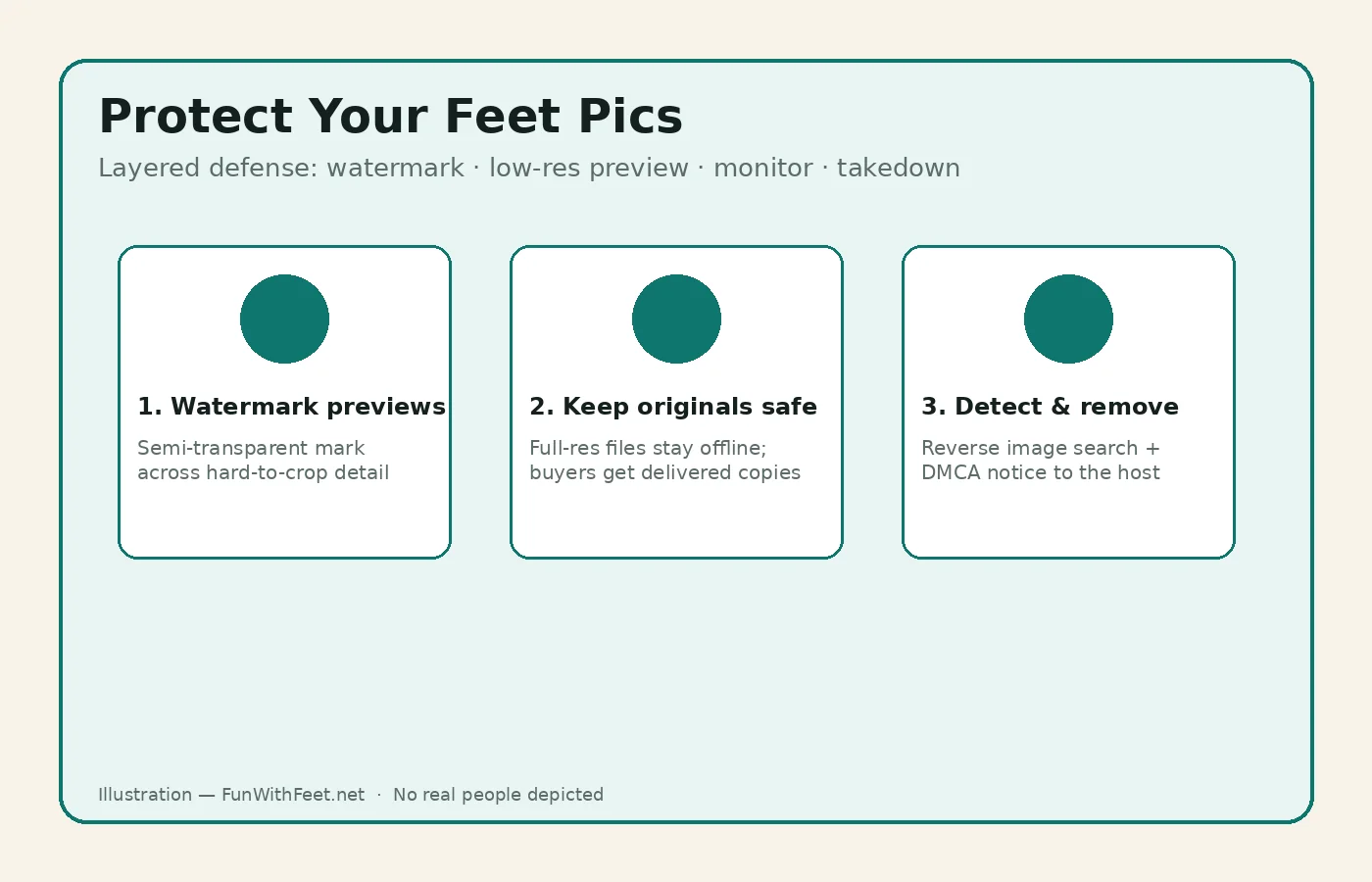
Watermark previews. A small, semi-transparent mark across the center of any preview photo makes free samples worthless to screenshot collectors.
Document everything. Screenshot the listing, the agreement, and the conversation. If a dispute ever happens, records are the only evidence that counts.
Never share what payment does not need. No real buyer needs your address, your full name, or your other social accounts. Treat every request for those as the red flag it is.
Our Pick for Buyer Volume: FeetFinder
Every protection above gets easier when the platform does the heavy lifting. FeetFinder handles payments through verified checkout, keeps delivery and order history in one place, and verifies buyers, which cuts off most of the scams on this list before they can start. If you want a marketplace where the safety defaults are already set for you, it is the one we recommend to sellers.
Disclosure: this is an affiliate link. If you sign up through it, we may earn a commission at no extra cost to you.
Create your FeetFinder seller profile
When a Deal Feels Off
Trust the pause. Scammers rely on speed and on your hope that this buyer is finally serious, and they count on new sellers not knowing what normal looks like. Normal looks like a buyer who pays through the platform, waits for delivery, and does not need your address.
There is no volume of sales worth chasing that requires accepting a risky deal. The market is big enough that the next legitimate buyer is always one message away.
Frequently Asked Questions
What is the most common feet pic scam?
Fake payment screenshots. A buyer sends an image showing a completed payment, pressures you to deliver immediately, and the payment either never existed or gets reversed. Always confirm the money in your own account before sending anything.
Can someone scam you with a payment screenshot?
Yes. Screenshots are easy to edit and prove nothing. The only proof of payment is the money appearing in your own balance, viewed on your own device.
Why do buyers ask to move to Telegram or Snapchat?
Because off-platform chats have no checkout records, no dispute process, and no buyer verification. Once the deal leaves the platform, every protection disappears and the scammer controls the terms.
What is the overpayment scam?
The buyer sends more than the agreed price, claims it was a mistake, and asks for a refund of the difference through another app. After you refund them, the original payment reverses and you lose the refunded amount entirely.
Do buyers ever ask for free samples before paying?
Scammers do. The free sample request is the most common opening move, because it converts your work into free content one "small ask" at a time. Real buyers pay first.
Are gift cards a safe way to accept payment for feet pics?
No. Gift card codes are untraceable and cannot be reversed, and the FTC lists gift card requests as a standard scam pattern. Ask for platform checkout or a standard payment method instead.
How do I know if a buyer is real?
Watch what they ask you to do rather than how their profile looks. A real buyer pays through the platform at market rates and asks for nothing that payment does not require. A convincing profile can still belong to a scammer.
What should I do if I already sent content and got scammed?
Stop responding, block the buyer, keep all screenshots of the conversation, and report the account to the platform where you met. If money was taken through a payment app, dispute the charge with that app right away.
Is selling on a platform actually safer than selling directly?
Yes, and by a wide margin. Platform checkout creates an order record, verifies buyers, handles disputes, and keeps your identity out of the transaction. Direct deals hand all of those jobs to you, and scammers specifically look for sellers who agree to them.

Jess writes the protective stuff: scam red flags, staying anonymous, watermarking, and what to never share. Calm, practical, slightly paranoid — exactly what you want in a safety writer.