On this page
- What Anonymity Actually Requires
- Start With a Seller Name That Has Nothing to Do With You
- Keep Your Face and Identifying Marks Out of Frame
- Scrub the Metadata Before Anything Leaves Your Device
- Build a Separate Setup for Selling
- How Payment Keeps Your Name Hidden
- Why We Recommend FeetFinder for Private Selling
- What Anonymity Can and Cannot Protect Against
- The Quick Anonymity Checklist
- Frequently Asked Questions
- Can you really sell feet pics without showing your face?
- Will buyers see my real name when they pay me?
- Do I have to show ID to sell feet pics anonymously?
- Can someone find me from a feet pic?
- Do photos contain my location automatically?
- Is it safe to sell feet pics on social media instead of a platform?
- What is the safest payment method for anonymous selling?
- Should I use a VPN to sell feet pics?
- Can I stay anonymous if I promote my feet pics on social media?
- What do I do if someone figures out who I am?
Anonymity is the first question almost every new seller has, and the honest answer is that selling feet pics anonymously is very doable. Thousands of sellers operate for years without a single buyer learning who they are. The ones who stay anonymous are not lucky. They set up a small number of protective defaults before their first sale, and then they never break them.
This guide walks through each of those defaults: the seller name, the camera frame, the metadata, the payment path, and the habits that keep your real identity out of the transaction completely.
What Anonymity Actually Requires
Think about anonymity in four layers, because a leak in any one of them undoes the others:
- Your seller identity: the name, email, and profile a buyer sees
- Your content: what the photos themselves reveal, including backgrounds and skin marks
- Your data: the metadata attached to every photo file
- Your money: how payment reaches you, and what name appears on it
A seller who uses a stage name but posts photos with their house in the background is not anonymous. Neither is a seller with perfect photos whose PayPal payment shows their legal name. The goal is to close all four layers at once, and each layer below has a straightforward fix.
Start With a Seller Name That Has Nothing to Do With You
Your stage name is the single most important anonymity decision, because it follows you everywhere: profiles, watermarks, social accounts, and every conversation with buyers.
Pick a name that shares nothing with your real one. No real first name, no birthday numbers, no hometown in the handle, and no crossover with usernames you already use anywhere else. Buyers search handles across platforms, and a seller name that matches your Instagram makes the separation pointless.
Practical rules that work:
- Choose something search-unique, so a buyer looking you up finds your seller profiles and nothing else
- Register the same stage name on every platform you might use, even ones you have not joined yet, so an imposter cannot claim it later
- Create a dedicated email address for selling that uses the stage name, and keep it completely separate from your personal accounts
- If a platform asks for a display name, the stage name goes there every time
Verification is a common worry here. Legitimate platforms do check identity documents to confirm you are an adult, and that check happens privately between you and the platform. It never becomes public, and buyers never see it. The paperwork proves your age to the platform; the stage name is what the world sees.
Keep Your Face and Identifying Marks Out of Frame
Faceless content sells. A large share of successful sellers never show their face at all, and buyers of feet content are there for feet, which means the framing you need is also the framing that protects you.
Crop above the ankle or keep your face out of frame, and be just as deliberate about everything else the camera can pick up:
- Tattoos and birthmarks: any distinctive mark on your feet, ankles, or hands can identify you to someone who knows it. Check every frame before posting.
- Jewelry: a recognizable ring or anklet that friends and family have seen is a small leak that adds up.
- Backgrounds: avoid mirrors, windows with reflections, bedding and decor that is recognizable from your other posts, and anything with your area visible outside.
- Screens: a paused TV or a notification banner in the background can carry a timestamp or an account name.
Do a quick scan of every photo the way you would proofread a message. Sellers who stay anonymous treat this as part of taking the photo, not a separate chore, because it takes ten seconds and prevents the only mistake that cannot be undone after upload.
Scrub the Metadata Before Anything Leaves Your Device
Every photo your phone takes carries EXIF metadata: the date, the device model, and often the GPS coordinates of where the shot was taken. That coordinate is a real risk, because it can place a photo at your home or workplace on a map.
Marketplace platforms strip metadata from uploads on their servers, and that protection is a genuine part of what they do. But direct deliveries through messaging apps and email do not always strip it, and a screenshot is the only method you fully control.
The habit that covers every case: before sending a photo anywhere, take a screenshot of the photo and send the screenshot, or use your phone's photo editor to crop and re-save the image. Both methods produce a new file with the metadata gone. If you post from a camera or a computer, check the file properties once and turn off location access for your camera app so GPS coordinates are never written in the first place.
Build a Separate Setup for Selling
Anonymous selling runs smoother when the selling life has its own equipment and accounts. None of this costs money, and it takes an afternoon:
- A dedicated email used only for selling, so no notification ever lands in the inbox your family sees
- Payment details that never cross over: use payment methods that pay out to your account without displaying your legal name to buyers, which is exactly what platform checkout does
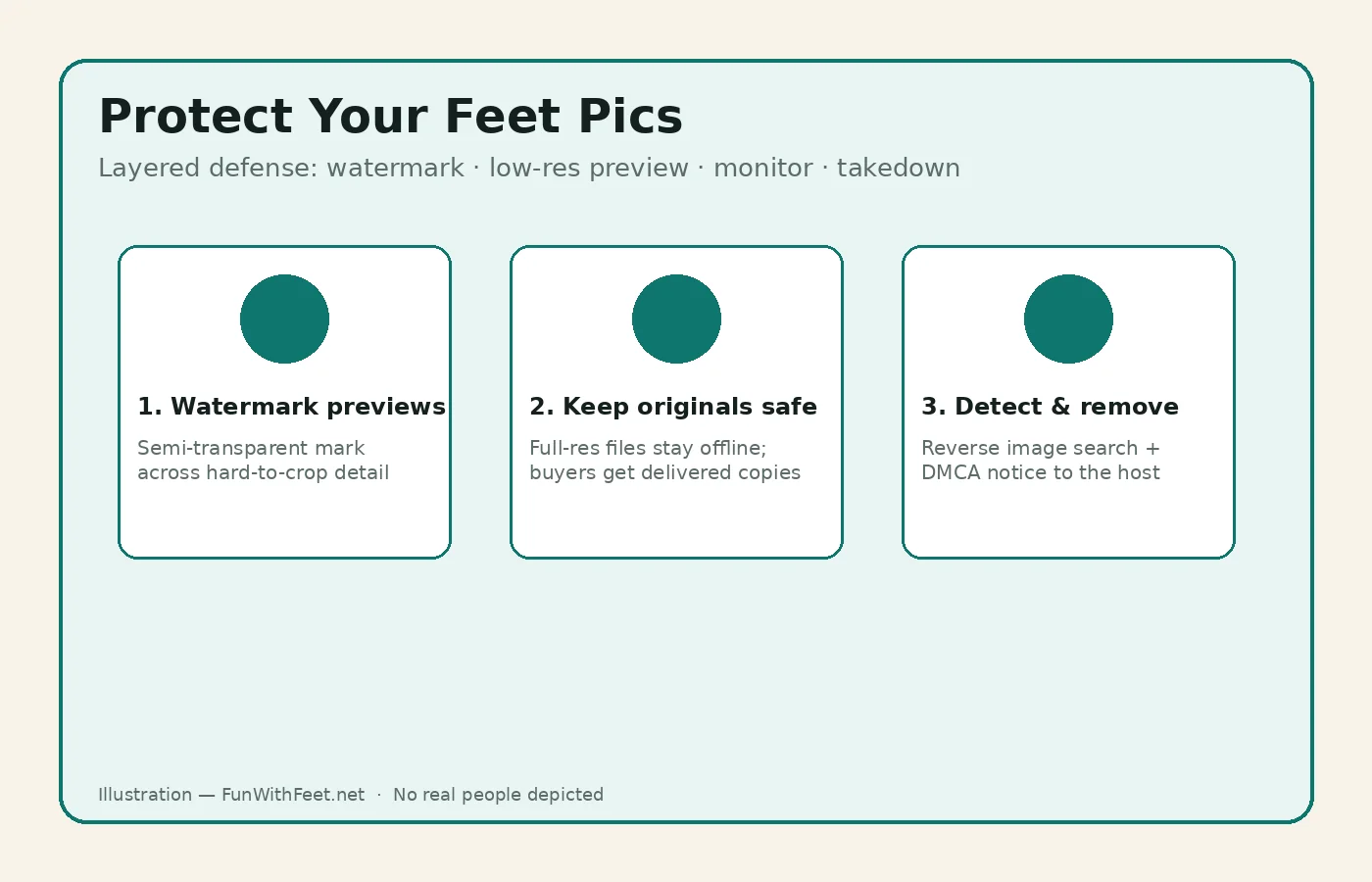
- A watermark that matches your stage name on every preview and, honestly, on everything, because watermarks both deter theft and keep stolen files advertising your alias rather than your identity
- A separate browser profile or app profile for selling accounts, so you never log into a selling account from a session where your personal accounts are open
- Optional: a VPN if you want your home IP address kept out of connection logs on sites you visit directly. Marketplaces with their own security already handle the buyer-facing side of this.
The point of separation is simple. If every selling activity lives in its own container, there is no accidental crossover. No posting the watermark photo to your personal account, no replying to a buyer from your real email, no payment arriving under your legal name.
How Payment Keeps Your Name Hidden
Payment is where many sellers accidentally expose themselves, so it deserves its own decision. If you accept money through a personal payment app or a direct transfer, your legal name, and sometimes your city, travels with the payment. A buyer who wanted to know who you are now has a starting point you handed them.
Marketplace checkout solves this at the structural level. When a buyer pays through a platform, the transaction runs through the platform's payment system, the buyer never sees your name or location, and the platform pays out your earnings to you privately. This is one of the strongest arguments for selling on a marketplace rather than taking direct payments. It is also why experienced sellers treat a direct payment app as a red flag in a buyer, not a convenience.
Why We Recommend FeetFinder for Private Selling
FeetFinder is our pick for sellers who want anonymity handled by default. Buyers pay through verified in-platform checkout, your personal details stay out of the transaction, and payouts reach you without your legal name ever appearing in front of a buyer. Add in buyer verification and active moderation, and the platform covers the payment and identity layers of anonymity for you.
Disclosure: this is an affiliate link. If you sign up through it, we may earn a commission at no extra cost to you.
Create your anonymous FeetFinder seller profile
What Anonymity Can and Cannot Protect Against
Honesty here matters, because the limits are as practical as the protections.
Anonymity done well protects you completely from strangers. A buyer on a marketplace has no name, no location, no face, and no payment trail leading to you. That covers the overwhelming majority of risk.
What it cannot do is make you unrecognizable to people who already know you. Someone who has seen your feet in real life, or who knows a distinctive tattoo, may make a connection in your content. That risk shrinks with the framing habits above, and it is the reason the content layer matters even when every account layer is perfect.
Screenshots are the other limit. Anyone can screenshot a photo they bought, and no protection reverses that. Watermarks are the counter. They do not stop a screenshot, but they keep your stage name attached to the image wherever it travels, which contains the damage and keeps a leaked file unlinked from your real identity.
The Quick Anonymity Checklist
Run through this once before your first post, and you are covered:
- Stage name picked, search-unique, and reserved on every platform you might use
- Dedicated selling email created and used only for selling
- Face, tattoos, and identifiable marks checked in every frame
- Backgrounds checked for reflections, screens, and recognizable items
- Location access turned off for your camera app
- Screenshot or re-save habit in place for every photo you deliver
- Watermark carrying your stage name applied to every image
- Payments running through platform checkout, never direct apps
- Selling accounts kept in a separate browser or app profile
Frequently Asked Questions
Can you really sell feet pics without showing your face?
Yes, and plenty of top sellers never do. Buyers of feet content are interested in feet, so crop above the ankle or angle your shots downward, and your face never needs to appear anywhere.
Will buyers see my real name when they pay me?
Not if you sell through a marketplace. Platform checkout keeps your legal name and location out of the transaction entirely. Direct payment apps are the opposite: your legal name usually travels with every payment, which is why experienced sellers avoid them.
Do I have to show ID to sell feet pics anonymously?
You verify your age with the platform privately during signup, and that document is never shown to buyers or made public. Every buyer-facing part of your profile, from the display name to the bio, uses your stage name.
Can someone find me from a feet pic?
Only if the photo contains identifying information: a GPS location in the metadata, a recognizable tattoo, your face, or a background that gives away where you are. Strip the metadata, check the frame, and the photo itself carries nothing that points back to you.
Do photos contain my location automatically?
Phone cameras often write GPS coordinates into the file's metadata. Marketplaces strip this on upload, but you should not rely on that alone: turn off location access for your camera and send screenshots or re-saved files so no metadata leaves your device.
Is it safe to sell feet pics on social media instead of a platform?
Social platforms have no checkout, no buyer verification, and no payment protection, and they push every seller toward direct messages where identity slips happen. If anonymity matters to you, a marketplace with private checkout is the safer container for the whole transaction.
What is the safest payment method for anonymous selling?
Platform checkout on a marketplace, without competition. The payment is processed by the platform, the buyer never receives your details, and your earnings are paid out to you privately. Gift cards and direct apps are the least safe options for opposite reasons: one is untraceable, the other is too traceable.
Should I use a VPN to sell feet pics?
It is optional. A VPN hides your IP address from sites you visit directly, which adds a layer if you also browse selling-related sites outside a marketplace. Marketplaces with their own security already handle the buyer-facing side, so treat a VPN as a bonus layer rather than a requirement.
Can I stay anonymous if I promote my feet pics on social media?
Yes, with separate accounts. Create promotion accounts under your stage name that never follow or interact with your personal profiles, and never cross-post the same photo to both. The crossover between the two accounts is the leak; the accounts themselves are fine.
What do I do if someone figures out who I am?
Do not engage, do not confirm anything, and do not reply to pressure. Screenshot everything, report the account on the platform where it happened, and block. Sellers with a clean separation between their selling identity and their real one give a blackmailer nothing to work with, which is exactly why the separation is worth doing properly from day one.

Jess writes the protective stuff: scam red flags, staying anonymous, watermarking, and what to never share. Calm, practical, slightly paranoid — exactly what you want in a safety writer.